










【温哥华乐活网 Lulu编译】这是《南华早报》9月16日的文章。就9月14日温哥华市中心发生的教联支持者与BC家长联盟成员发生的冲突进行了报道。里面提到BC省家长联盟发布在温哥华乐活网上的声明。
针对南华早报的这篇报道,BC家长刘智达指出,“此文有1点属于捏造事实。我当时绝对不在现场,身在本拿比教㑹,我有录影为证。作为负责任记者怎能报导我是‘BCPF中的一些示威者 … 包括 … Charter Lau?’这是谎言及抹黑。”
另外一位家长锡安也表示,“我们不是中国家长,我们也是加拿大国籍。这篇文章标题就非常有挑动族裔冲突的嫌疑。我们是纯粹的家长,没有任何党政背景,诉求也很简单:让孩子上学,不增加税。戴口罩不是怕被别人认出来,而是代表家长、纳税人的声音没人听,用沉默来抗议。网站及脸书的取消也非文章所暗示的害怕。总之这篇文章是不友善的,故意扭曲的。”
以下是这篇报道的简要编译。编译不准确的地方,请敬请理解并指出。
家长组织成员与温哥华华人社团一同反对学校罢工游行,与教师工会发生冲突,进行了一场愤怒的混战。
BC省家长联盟(BCPF)成员戴着口罩,拉着大横幅,上面写着英文和中文,试图在温哥华美术馆外进行集会,以抗议罢工行动。
这一争端已经持续了三个月,BC省的学生在新学期开学两个多星期了都没有正常开课。
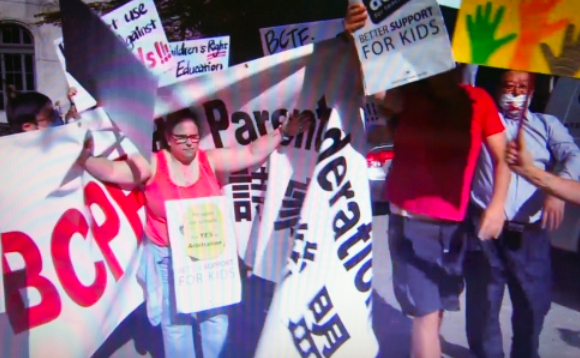
图片说明原文:Members of a Chinese activist group, the BC Parents’ Federation, clash with rival pro-union protesters at a rally in Vancouver on Sunday amid a strike by teachers in British Columbia. Photo: CBC
在BCPF成员和教师工会支持者被警察分开以前,他们一直在相互指责。这件丑闻在几个小时后就被CBC新闻曝光。
记者多次通过电子邮件发送采访请求,但BCPF并没有回应。然而,周日,一张贴在本地中文门户网站温哥华乐活网(Lahoo.ca)的一份声明中,该联盟呼吁教师工会立即停止罢工。
声明说:“根据BC省学校法,学生享有教育的权利。如今,这种权利被公然侵犯。”
“因为教师罢工,50多万学生失学,这对公立学校造成了极大的破坏。”
“罢工不仅影响BC省的学生和家长,它还让超过13000名国际学生承受了巨大的经济损失。”
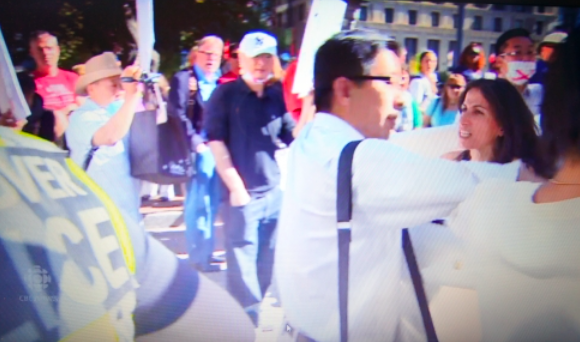
图片说明原文: The dispute has lasted three months and has seen pupils in British Columbia go more than two weeks without classes since the new school year was due to have started. Photo: CBC
BC省华人社团的学者谢博士(Dr Justin Tse)说,虽然BCPF希望让孩子们回来上课的愿望其他反对罢工的人也都感受到了,但还是有一股强大的反工会主义暗流在推行这次抗议。
谢博士说:“我的感觉是,有一种观点认为,工会停止工作了,而大部分中国移民也有这种观点”。华盛顿大学的一位博士后研究员说: “对他们来说,这不仅仅是教育,还与工会相关。”
BCPF已通过中文社交网络赢得一些支持者,在周日的抗议活动中有几十位华裔成员出现。该协会一直试图扩大推广到非中国父母之中,但目前他们似乎已经中止这种推广。周日在Facebook页面和英文网站上可以看到他们在寻求新的BCPF成员,但在晚上被撤销了。
谢博士说:“很多中国移民都害怕公众抗议,他们希望媒体意识到到他们人数众多的抗议群体,但他们不希望被一个个挑选出来作为代表,所以你才会看到他们戴着口罩。你真的不能两者兼得,但这毕竟是很感性的。“
谢博士说,在BC省发起的那些保守的中国政治活动,是由一种注重大多数人的统治方式的,“民主的具体愿景”,而并不是在强调其他方面,如商议,达成共识和责任。
“有这个意义上说,民主意味着你能表达个人观点,无论多么离谱,因为这是言论自由,而最终由数量决定。”谢博士说。 “这种观点就是说,民主只是意味着多数获胜,少数服从多数。”
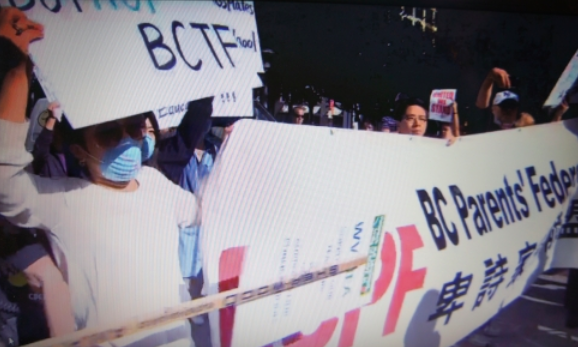
图片说明原文:There were shoving and shouting matches between BCPF members and union supporters, before they were separated by police. Photo: CBC
上周四,BCPF参加了一个由两个本地的华人社团,中国协会加拿大联盟(CACA)和加拿大社区服务协会(CCSA)举办的会议。根据中文媒体世界日报的报道,这两个组织呼吁家长要“积极表达他们的意见……投票给可以为华人社团说话的政客”。
据世界日报报道,CCSA副总裁Harris Niu说,”罢工不仅损害了BC省得教育质量,而且还损害了我省的国际声誉”。
根据CCSA官网介绍,CCSA的董事会全是中国大陆的移民,大多是商人。它曾在温哥华太阳报上打过一个大广告以盛赞北京在管理西藏方面做出的“宏伟”工作。
BCPF中的一些示威者,在五月份有关变性学生的新政策上一样持反对意见。其中包括香港著名移民和社会保守派,曾试图入选本拿比学校董事会的Charter Lau。
上周五,温哥华太阳报报道,家长组织的代表团已要求中国领事馆对罢工进行干预。领事馆官员称,要教育部代表向家长们转达中国领事馆的关心。
据称BC省教师联合会和省政府于昨天达成了初步协议,结束了罢工,但双方都没有立即证实调停,宣布这项协议。
原文:http://www.scmp.com/news/world/article/1593861/chinese-parents-clash-striking-canadian-teachers
Chinese parents clash with striking Canadian teachers as school year fails to start
Websites linked to masked protesters disappear in wake of ugly scenes in Vancouver, as school year in British Columbia enters third week without classes
PUBLISHED : Tuesday, 16 September, 2014, 3:26pm
UPDATED : Wednesday, 17 September, 2014, 8:45am
Ian Young in Vancouver
ian.young@scmp.com
Members of a parents’ group forged within Vancouver’s Chinese community to oppose an ongoing school strike have gone to ground after they gatecrashed a rival teachers’ union rally and were involved in angry scuffles.
Members of the British Columbia Parents’ Federation (BCPF), some wearing surgical masks, unfurled a large vinyl banner carrying their group’s name in English and Chinese as they attempted to march on a larger rally outside the Vancouver Art Gallery in support of the industrial action on Sunday.
The dispute has lasted three months and has seen pupils in British Columbia go more than two weeks without classes since the new school year was due to have started.
There were shoving and shouting matches between BCPF members and union supporters, before they were separated by police. In the hours after the ugly incident was shown on CBC news, websites associated with the BCPF went offline.
The BCPF did not respond to multiple e-mailed requests for an interview. However, in a statement posted on Sunday on Chinese web portal Lahoo.ca, the group urged the teachers’ union to immediately end the strike.
“Under the BC School Act, students’ entitlement to education is a right. Today, this right has been blatantly violated,” the statement said.
“Because of the teachers’ strike, more than 500,000 students have been locked out of school causing great disruption to public schools.
“Not only has the strike impacted students and parents in BC significantly, it has also incurred great financial loss to over 13,000 international students.”
Dr Justin Tse, an academic who has studied activism within the British Columbia Chinese community, said that although the BCPF’s desire to get children back in class was shared with other opponents of the strike, there was also a strong undercurrent of anti-unionism in general that ran through the protests.
“My sense is that there is a view that unions disrupt business, and most Chinese migrants have this view that unions get in the way of the free market,” said Tse, a post-doctoral fellow at the University of Washington. “For them, it’s not really just the educational stuff – it’s the union stuff.”
The BCPF has garnered supporters via Chinese-language social media, and the couple of dozen members at Sunday’s protests all appeared ethnically Chinese. The federation has attempted to widen its outreach to non-Chinese parents, but these efforts appear to have been aborted, for now. A Facebook page and an English-language website seeking new BCPF members were visible on Sunday, but were taken offline that night.
“A lot [of Chinese immigrants] are kind of scared of public protest,” said Tse. “They want the media to capture their numbers at a protest, but they don’t want to be singled out as individuals, so you get the face mask thing. You can’t really have it both ways, but that is the sentiment.”
Tse said conservative Chinese political activism in BC was informed by “a specific vision of democracy” that focused on majority rule alone, without emphasising some of its other aspects, such as deliberation, consensus and accountability.
“There is this sense that democracy means you get to say your private views in public, no matter how outrageous, because that’s free speech, and that it is all about getting numbers,” said Tse. “This view is that democracy just means majority wins, majority rules.”
The BCPF protest came in the wake of a meeting called last Thursday by two local Chinese groups, the Canadian Alliance of Chinese Associations (CACA) and the Canadian Community Service Association (CCSA). According to an account in the Chinese-language World Journal, both organisations urged parents to “actively voice their opinions … while voting in elections for politicians who can speak for Chinese communities”.
CCSA vice-president Harris Niu said the strike “had not only compromised the quality of education in British Columbia but had also tarnished the province’s international reputation”, World Journal reported.
The CCSA’s board is made up entirely of mainland Chinese immigrants, mostly businessmen, according to its website. It once placed a large advertisement in The Vancouver Sun praising Beijing’s “magnificent” work governing Tibet.
Among the BCPF protesters were some of the same people who vocally opposed the Vancouver School Board’s adoption of a new policy on transgender students in May. They included Charter Lau, a prominent Hong Kong immigrant and social conservative who has previously sought election to the Burnaby School Board.
On Friday, The Vancouver Sun reported that a delegation of parents had asked the Chinese consulate to intervene in the strike. Consulate officials reportedly met representatives of the education ministry to relay the parents’ concerns.
A tentative deal to end the strike was reportedly reached between the BC Teachers’ Federation and the provincial government early yesterday, but neither side immediately confirmed the deal announced by a mediator.
Survey shows split in BC society over teacher’s strike
Chinese-speaking parents are far more likely to blame the teachers’ union than the provincial government for the ongoing school strike in British Columbia, according to a survey.
The views revealed by the Social Insights poll last month put the Chinese community at odds with broader British Columbian society, which was more likely to believe the union had done more than the government to end the strike, another poll found.
“This finding paints a different picture from what has been reported in the media from most British Columbians,” said Sonny Wong, a partner in Social Insights. “The sensibilities of the Chinese community are different and should be observed.”
Social Insights surveyed 313 Chinese-speaking British Columbia residents via the WeChat Chinese messaging platform. It found that 39.4 per cent of respondents put most of the blame for the strike on the BC Teachers Federation, while only 3.9 per cent put most of the blame on the government.
In contrast were the results of an Insights West poll of 800 British Columbia residents conducted for CTV over the weekend, which asked which side had done more to end the dispute. Forty-eight per cent favoured the BCTF, while 21 per cent sided with the government.
Teachers are seeking higher pay and smaller class sizes.
Social Insights found that 98 per cent of its Chinese-speaking respondents were either concerned or very concerned about the strike.
The longer a respondent had been living in Vancouver, the more likely they were to blame the teachers’ union for the strike, Social Insights found. Of those who had lived in Vancouver for five years or less, 29 per cent primarily blamed the union; of those who had lived in Vancouver 16-20 years, that rose to 58 per cent.
Students protest against the education dispute in Vancouver on September 2. Photo: Xinhua
This article appeared in the South China Morning Post print edition as School strike row exposes ugly side of people power
(本文由温哥华乐活网结合http://www.scmp.com/信息编译而成。如果涉及相关网站不愿温哥华乐活网使用,请通知本网处理。请转载网站注明来源:温哥华乐活网及编译者姓名,如经发现引用文章不注明来源,本网将追究相关责任。)
本文发布于: 2014-9-17 00:58